★★★★★
They heard his voice again
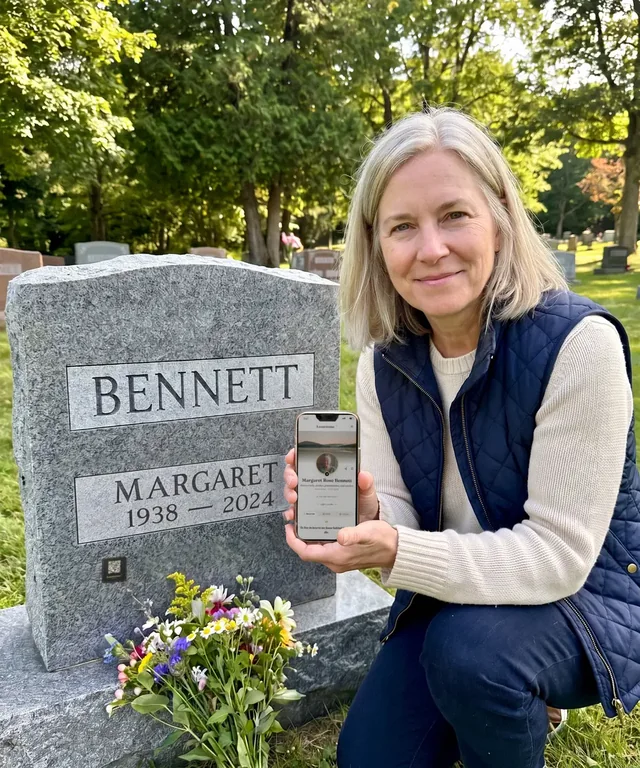
“The first time my grandchildren scanned it at the cemetery, they got to hear their great-grandfather’s voice. I cried. It’s the most meaningful thing we own.”
Margaret R. · Verified buyer
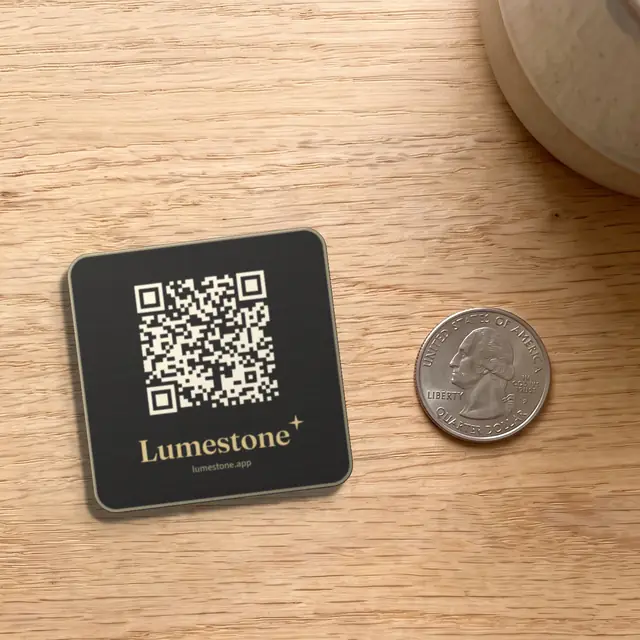 Actual size: 2 × 2 in, next to a quarter
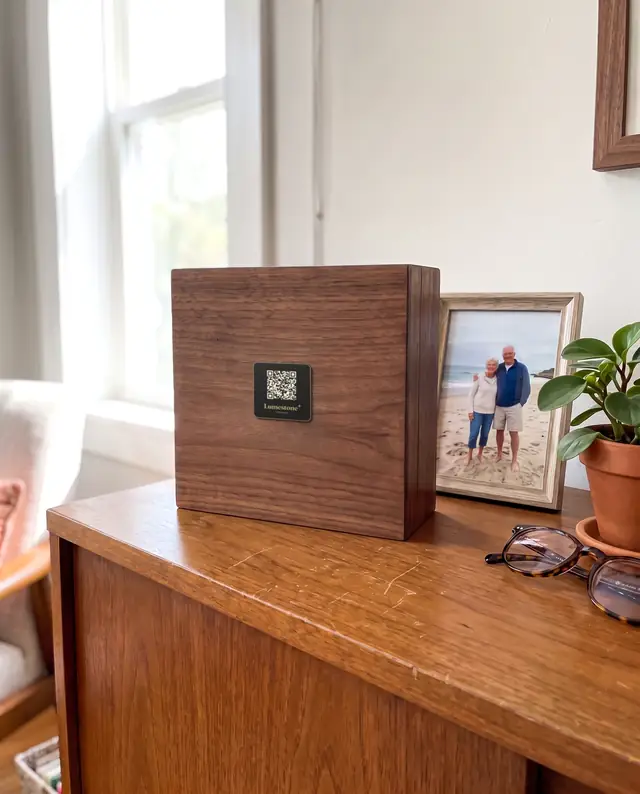 A second one for home: urn, frame or keepsake box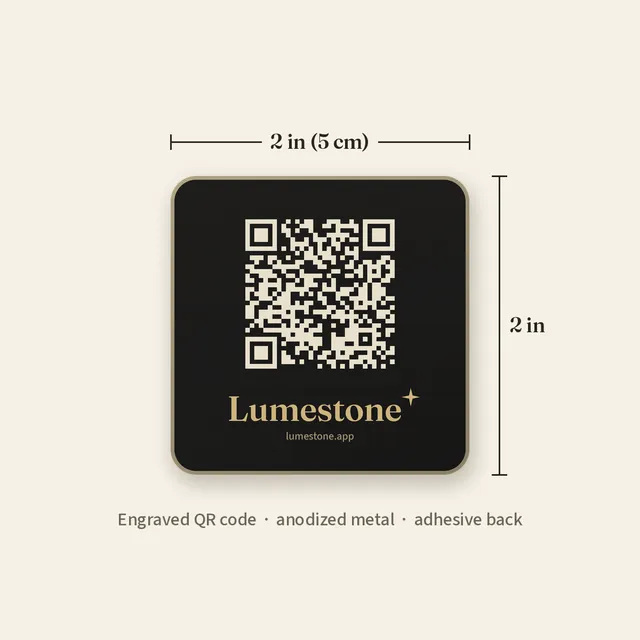
A small engraved plaque for the headstone. Point any phone camera at it and their photos, videos, voice and life story open.
Same page or separate pages. Each plaque can open its own memorial or share one. Every page is included.
Start their memorial · $47.99Order today and it ships within 48 hours. Your page link arrives by email within minutes.
“Setup took me five minutes and I’m 71. Now the whole family adds photos. It turned a cold stone into something alive.”
It’s 2 × 2 in, smaller than most vase medallions, and the adhesive is already on the back. There’s no drilling and no damage to the stone. When cemeteries object to add-ons, the concern is usually damage to the monument. Rules vary, so call the office if you’re unsure. It also works on an urn, a frame or a keepsake box at home.
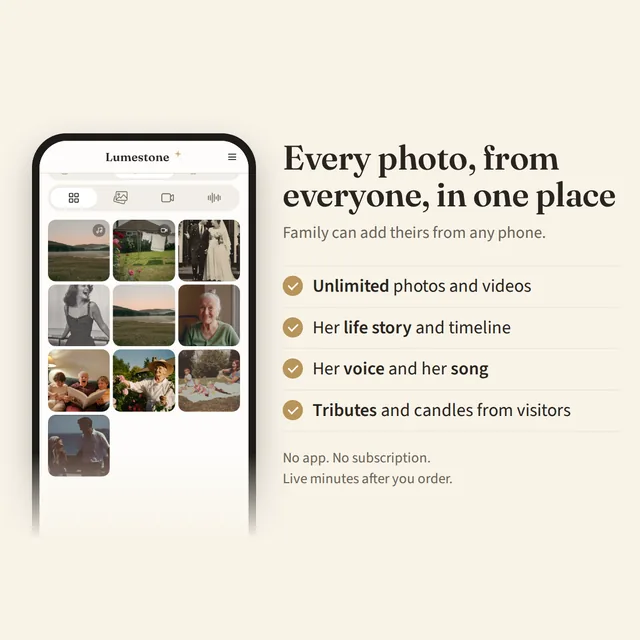
One engraved Lumestone plaque, 5 × 5 cm (2 × 2 in), in anodized metal with a champagne-brass rim and adhesive already applied. It opens a memorial page with unlimited photos and videos, a life story, a life line, their voice, a slideshow set to their song, tributes, and a candle visitors can light without an account. No ads, ever. You choose public or private.
No. Today’s price covers hosting, daily backups, unlimited storage and all future updates. There’s no yearly fee and no saved card that could expire and take the page offline.
It can’t hold the story they told every Christmas, or the photos sitting in old shoeboxes and on a dozen relatives’ phones.
Lumestone puts it all on one page and attaches that page to the place people already go to remember them. Grandkids, old friends and neighbors can scan the plaque and get to know who they were.
Visitors don’t need an app or an account, just the camera on their phone.
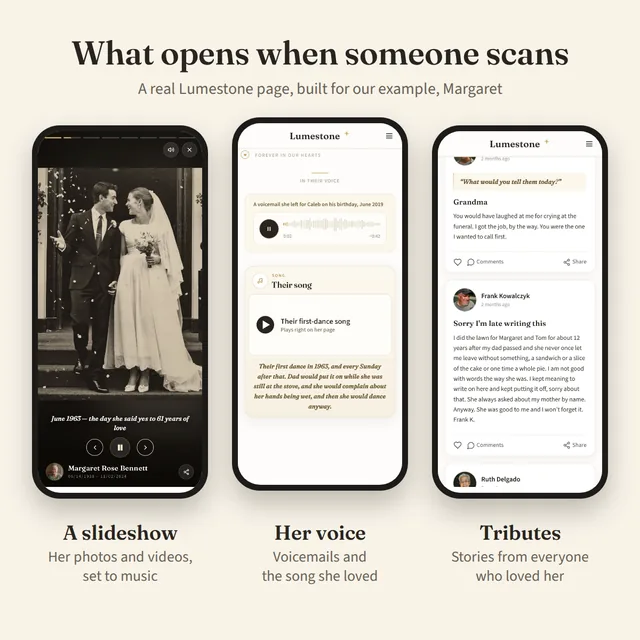
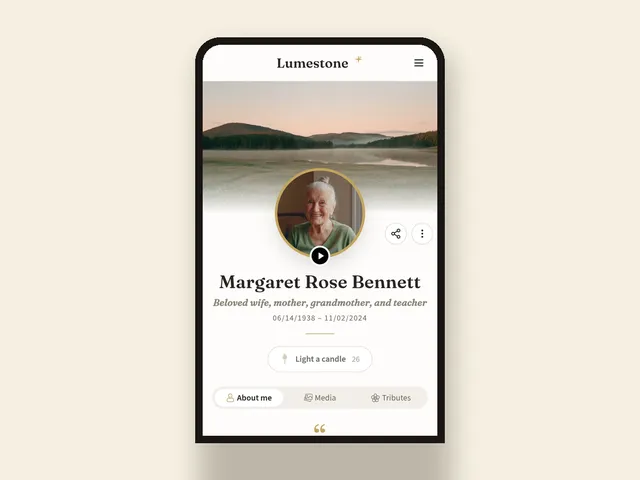
Start their page todayThis is what a visitor sees at the grave: a slideshow of Margaret’s photos and videos set to music, then her life story, her life line, and the tributes her family added. It opens in the phone’s browser, so there’s nothing to install.
“The first time my grandchildren scanned it at the cemetery, they got to hear their great-grandfather’s voice. I cried. It’s the most meaningful thing we own.”
“We gave one to my mother for dad’s grave. She scans it every Sunday after church, just to hear his laugh again.”
“What decided it for me was that there is nothing to renew. My children won’t inherit a bill for something I set up. It’s paid, it’s done, and it stays.”
“Even our funeral director asked where we got it. The page is stunning. People don’t expect something this beautiful from a QR code.”
The plaque ships while you build the page, so you can start right away.
 1
1Your private link arrives by email within minutes. No account needed. Add one photo and stop there, or invite family to add theirs.
Minutes after you order
2Engraved to order with its own unique code, already linked to your page. Nothing to configure.
Within 48 hours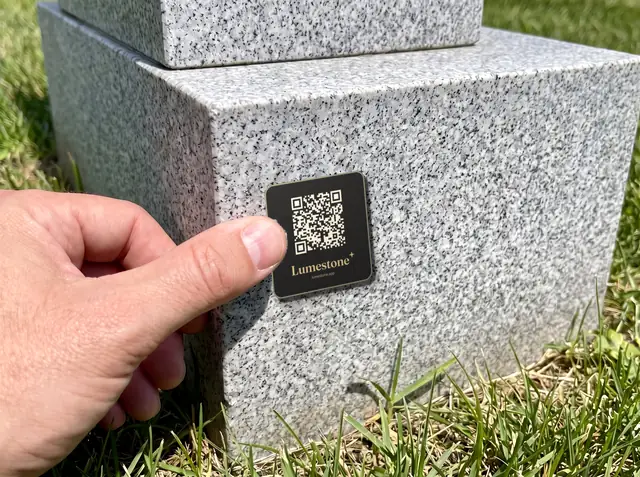 3
3Clean and dry the stone, peel off the backing and press hard for a minute. Best on a dry day above 50°F (10°C). No tools, drilling or stonemason.
About 5 minutesIf you can send a text, you can set this up. If you get stuck, someone on our team will reply, usually within a day.
We read the one-star reviews for QR memorial plaques. The same complaints kept coming up, so we built Lumestone to fix each one.
 Lumestone Lumestone | Many QR plaques | |
|---|---|---|
| Fees after purchase | ✓None | Often monthly or yearly plans |
| Videos | ✓Upload from your phone | Often YouTube links only |
| Photos | ✓Unlimited | Often capped around 50 |
| The code | ✓Engraved into metal | Often printed under film |
| If it stops scanning | ✓Replaced free | Varies |
| Ready to use | ✓Minutes after ordering | When the plaque arrives |
| Price | $47.99 once | $60–$100 plus fees |
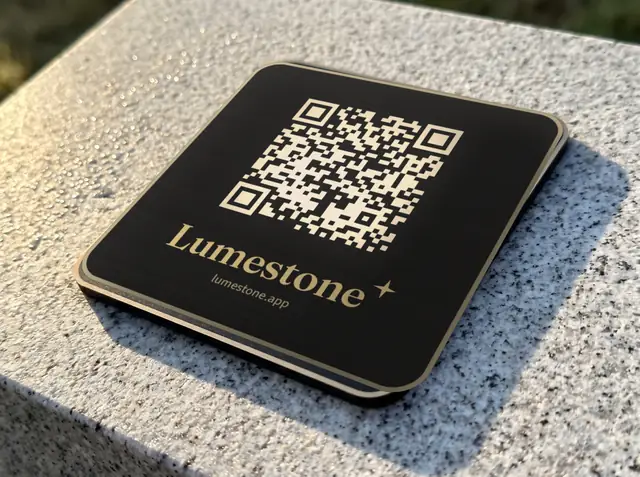
Many cheap plaques print the code under clear film. Sun fades the ink to gray, the film lifts, and after a winter the code won’t scan. Ours is engraved into anodized metal, so there’s no ink or film to wear off. QR codes also store their data more than once, so rain, pollen or a scratch from a mower rarely stops a scan.
Lifetime scan guarantee. If your plaque ever stops scanning, we replace it free for the life of the memorial. This isn’t limited to manufacturing defects.
30-day money-back. If it isn’t right for your family, send it back within 30 days for a full refund, no questions asked.
Nothing to renew. Hosting and backups are paid up front. We never delete a page for non-payment because there are no payments to miss.
A plaque on the headstone helps whoever visits. It doesn’t help a daughter three time zones away on a Tuesday night. So many families add a second plaque for an urn, a photo frame or a memory box, linked to the same page.
“We put one on the headstone and keep one at home. Every visitor scans it and leaves a memory.”Sofia M., Verified buyer
The second plaque in the 2-pack is $32, instead of $47.99 on its own.
No. You pay once and that’s the full price. There’s no subscription, no yearly fee and no per-plaque charge. Your payment covers hosting, daily backups, unlimited photo and video storage and all future updates.
With industrial adhesive that’s already on the back. You don’t drill anything and no holes are left. Cemetery rules vary, so check with the office if you’re unsure. It also works on an urn, frame or keepsake.
The code is engraved into anodized metal, so there’s no ink to wash out and no laminate to peel. It’s made for rain, frost, heat and UV, and if it ever stops scanning, we replace it free.
Your link arrives by email within minutes, so you can build the page and send it to relatives the same day. Plaques ship within 48 hours. If you need it by a certain date, email us after you order and we’ll do everything we can.
No. You add photos from your phone the same way you’d send them to family, and the plaque is peel and press. If you get stuck, email us and a person will help.
As many as you have. There’s no photo, video or storage limit. Videos upload straight from your phone or computer, so you don’t need YouTube links.
Yes. You can switch between public and private at any time, and the plaque stays the same. Only people you invite by email can see a private page.
Yes. Many people order one for a grieving parent, sibling or friend. Start the page yourself, then add them as a manager so they can add their own photos and stories.
Up to you, plaque by plaque, while you set them up. Each plaque can open its own memorial page, for example one for each grandparent, or several can open the same page, like one on the headstone and one on the urn at home. Every page is fully included, with no extra fee per page or per plaque.
With theft and loss cover (+$9 once, covering every plaque in your order), we send a free replacement for life, already linked to the same page. Without it, you can order a new plaque and link it to your existing page in a minute. If a plaque simply stops scanning, we replace it free either way.
We won’t promise “forever.” Your page is never deleted for non-payment, because there are no payments to miss. If we ever had to shut down, you’d get plenty of notice and a full export of every photo, video and word you uploaded. Whoever you use, keep your originals somewhere safe too. What happened when other memorial sites shut down.
Yes. You can add other family members as managers so everyone can contribute photos, stories and tributes together.
We do. That’s what your payment funds. Everything is hosted on professional infrastructure, backed up daily and kept ad-free, and your photos, videos and stories are never deleted for non-payment, because there is no payment to miss. If we ever had to stop operating, you’d get plenty of notice and a full export of everything you uploaded.
No. The plaque carries only the code and a small Lumestone mark. The stone already carries their name, and the plaque is designed to sit quietly in a corner without competing with the inscription.
Yes. The plaque and page work the same way for a pet, on a grave marker, an urn or a keepsake at home.
No. The code is a fixed web address engraved into metal, so it cannot expire, be re-registered or be sold on to somebody else. What it points at is your memorial page, and keeping that page online is our job, not another bill: it is covered by the single payment you make when you order. There is nothing to renew and nothing that can lapse, so the plaque on the stone never needs replacing. And if the plaque itself ever stops scanning, we replace it free for life.
It almost always still scans. Every QR code stores its data more than once, so pollen, rain, mud and light scratching rarely stop a read. Because the code is engraved rather than printed, a scratch changes how the light falls but leaves the cut pattern underneath intact. The one real limit is the three large squares in the corners: a scanner uses those to find the code before it reads anything at all. If moss or snow covers them, wipe the face with plain water and a soft cloth and it reads again.
No, and it’s better to know that before you go. The code holds a web address, so the phone needs a data connection to open the memorial. Older church cemeteries and rural cemeteries sometimes have very little coverage. Walk to the plot with a phone before you decide where the plaque goes and check the signal where a visitor would stand. It is also worth emailing the memorial link to the family, because most relatives will not stand at the grave in a given year but will open a link on a birthday.
Yes, for as long as you want to. The plaque holds a link, not the content, so nothing you change on the page needs a new plaque. You can add photos years later, rewrite the life story, swap the song, switch the page between public and private, and add family as managers long after the plaque is on the stone. That is the practical difference between a memorial page and an inscription: a grandchild born in 2040 can be added to one and never to the other.
Usually, with patience, but plan the position rather than rely on it. The adhesive is industrial and meant to be permanent. Removing it means warming the plaque gently with a hair dryer, working behind it with fishing line or dental floss, then lifting the residue with a citrus-based adhesive remover. On polished granite that leaves no trace; on marble or other porous stone a faint outline can remain. If you want the memorial in two places, a second plaque linked to the same page is the easier answer.
Plain water, a soft cloth, a gentle wipe, then dry it. That is the whole routine and it is rarely needed more than once a year. Avoid scouring pads and abrasive creams, which scratch the finish and dull the contrast the code depends on. Whatever you use on the headstone ends up on the plaque, so follow the same conservation advice: the National Park Service recommends soft brushes and neutral-pH cleaners only, and warns against wire brushes, power washers and bleach. All three damage stone.
Very likely, for two reasons. The code is an ordinary web address in a published international standard that phone cameras have read natively for years, so nothing proprietary sits between the plaque and the page. And the address is ours to keep serving. Nobody can honestly promise what a phone will do in 2046, so we cover the half we control: if the plaque ever fails to scan we replace it free, and the page behind it stays hosted and backed up without a further charge to you.
It is 5 × 5 cm, about two inches square, which is smaller than most vase medallions and about the size of a large postage stamp. On an upright stone it sits quietly in a lower corner without competing with the inscription. It carries no name and no dates, only the code and a small Lumestone mark, because the stone already carries their name. Nothing is drilled: the industrial 3M adhesive is already applied to the back, so there are no holes, no bracket and no work for a monument company.
Yes, with something to watch on each. Polished granite is the best surface there is, dense and close to non-porous. Marble, limestone and sandstone are softer and more porous, hold moisture at the bond line and can keep a faint adhesive outline, so consider the base rather than the face. Bronze and stainless are fine once cleaned of wax or polish. Sealed wood holds well, raw weathered wood does not. Glass and glazed ceramic are excellent, though a curved urn gives the adhesive much less contact, so use the flattest area you can find.
The plaque copes well with both. It is engraved anodized metal, so there is no ink to wash off and no laminate to lift, and anodized finishes are specified for exterior use in coastal conditions. The weak point in a freezing climate is not the plaque but the bond underneath it: moisture in porous stone freezes at the bond line and pries slowly across several winters. Dense polished stone and a mild, dry application day are what prevent that. Near the sea, an occasional rinse with fresh water is all it asks.
Yes, and many families do. Your access link arrives by email when you order, so the memorial page can be built and shared with relatives while the stone is still months away. Keep the plaque indoors in its packaging until the monument is set. When you do fit it, choose a mild dry day: 3M’s guidance for this class of tape asks for a surface above roughly 50°F (10°C), and cold stone is the most common reason a plaque later works loose.
Yes. The same plaque works on an urn, a columbarium niche, a memorial bench, a tree marker or a keepsake box at home, and families who scattered ashes often make the object at home the fixed point instead of a grave. Two practical notes. Curved surfaces give the adhesive less contact than flat stone, so use the flattest face available. And a bench or a tree in a park usually belongs to the city or a land trust, so ask them the same way you would ask a cemetery office.
You do. Uploading something to a memorial page does not hand it to us. We store it and display it so the page works, and that is all it is used for. There is no advertising anywhere on a Lumestone memorial and we do not sell data. You can delete anything you have added at any time, and you decide who else may add to the page by choosing who becomes a manager. If the memorial is private, only the people you invite by email can see any of it.
Yes, though not yet as a single click. A one-button export of an entire memorial is on our list rather than in the product today, so here is how it works in the meantime: you can save individual photos and videos straight back out of the page, and if you want a copy of everything at once, write to us and we will put the whole archive together for you. The advice we give every family, and it applies to every provider including us, is to keep your own originals somewhere safe rather than treat any website as your only copy.
Nothing stops. There is no yearly payment to fail, no card to expire and nobody who has to remember a renewal on your behalf, which is the part families worry about most. The page stays exactly as you left it. Add at least one family member as a manager early, ideally somebody a generation younger, so there is always someone who can add to it and look after it. Adding them is included and it takes a minute.
Only if you choose to make it public. A public memorial can be found by search engines, which is how old colleagues and distant relatives sometimes find their way to it. A private memorial is visible only to the people you invite by email, so there is nothing there for a search engine to open. You can switch between the two at any time and the plaque never changes. Note: if a page has been public for a while, search engines can hold a cached copy for a short time after you make it private.
Yes. A new plaque can be pointed at an existing memorial page while you set it up, so one on the headstone and one on the urn at home open exactly the same photos, stories and tributes. There is no hosting fee either way, so a later plaque never adds a running cost. If you already know you want more than one, the two-pack at $79.99 and the three-pack at $111.99 cost less than ordering singly.
Yes, and we recommend it. Hold the plaque against the stone with the backing still on and scan it from where a visitor would stand. Check the cell signal while you are there. Then clean the surface, peel and press hard for a full minute, and leave it alone for a day while the adhesive sets.
You remove it. Tributes are yours to manage: as the owner, or as a manager you have added, you can delete anything left on the page, and nothing a visitor writes is permanent. If it keeps happening, switching the memorial to private stops it entirely, since then only the people you invite by email can see or add anything at all. And if someone is being persistent, write to us and we will help. It is rare, but it is a fair thing to ask before you put an open page behind a code on a public stone.
Add one photo, send the link, and let relatives add theirs. The plaque ships within 48 hours.
Start their memorial 30-day money-back · Lifetime scan guarantee · No subscription